Chapter 19
From Florence to Lucca, following the women of jazz
Some journeys begin with a specific destination, while others, almost without us even realizing it, turn into new chapters of a story. And so, after following the traces of women in jazz through the streets of Paris, here I am again in Italy, my first home. This time, in Tuscany!
Two trips and two nearby cities: Florence and Lucca. Two places that each tell, in their own way, the story of a beautiful region where art, history, and music seem to meet around every corner.
And there I am, as always, with my eyes and ears wide open, ready to discover new stories, new voices, and new women in jazz.
So… Le Jazziste by Mary goes to Tuscany!

There is Florence, with its streets, monuments, and artistic history, and then there is Lucca, with its city walls, squares, and that intimate charm that makes even simply getting lost in its narrow streets such a pleasure.
But this time, in Lucca, I also had a very special musical reason for being there: to follow the footsteps of Lucca Jazz Donna. A festival that places at its very heart what I try to tell through Le Jazziste by Mary: the women who make jazz, their voices, their instruments, their compositions, and their artistic journeys.
🌹 Lucca Jazz Donna: jazz told by women
Founded in 2005 and promoted by Circolo Lucca Jazz, Lucca Jazz Donna is a festival entirely dedicated to female talent in jazz, with the aim of celebrating singers, composers, arrangers, and instrumentalists, both Italian and international.
In 2026, for its twenty-second edition, the festival presented four summer evenings, from August 6 to 27, in the evocative cloister of Santa Caterina at Lucca’s Real Collegio, with free-admission concerts.
A programme spanning different musical languages and traditions, from vocal exploration to contemporary cross-genre influences, offering space for multiple expressions of female artistry [1].
Three women: three different musical universes, connected by a red thread of silk
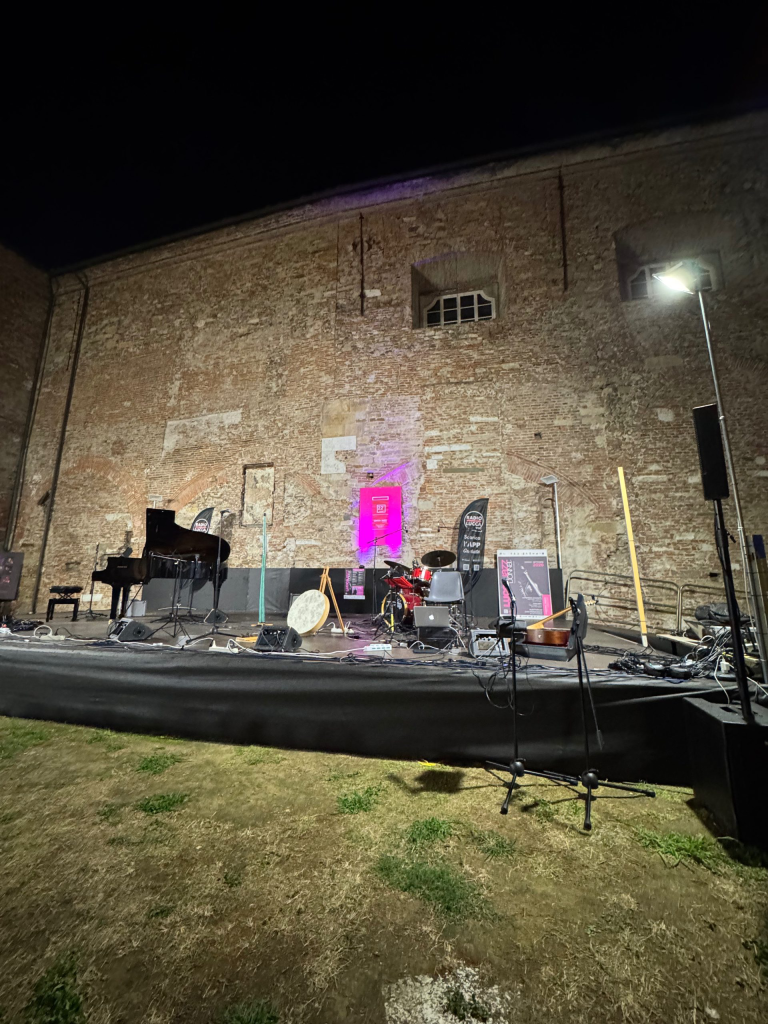
On August 27, the final evening of the summer programme, the stage of the Real Collegio welcomed three projects led by three different women musicians.
Giulia Vazzoler, singer and pianist, opened the evening with Per Elisa, a project that intertwines music and cultural outreach through contemporary reinterpretations of classical composers, including Beethoven, Chopin, Debussy, and Schumann.
It is interesting that a jazz festival invited a classical pianist; this very observation was shared with the audience by the evening’s first performer herself, who was surprised by the invitation…
Perhaps because jazz is the genre par excellence, capable of going beyond itself and offering every artistic personality the opportunity to express their true self.
Next, Martina Lupi presented Dannate salvatrici, accompanied by Manuel Petti on accordion and piano and Mattia Lotini on guitar. A recording project that explores the many facets of female identity, engaging with its ancient archetypes and seeking to move beyond the stereotypes that, unfortunately, still inhabit our everyday lives.
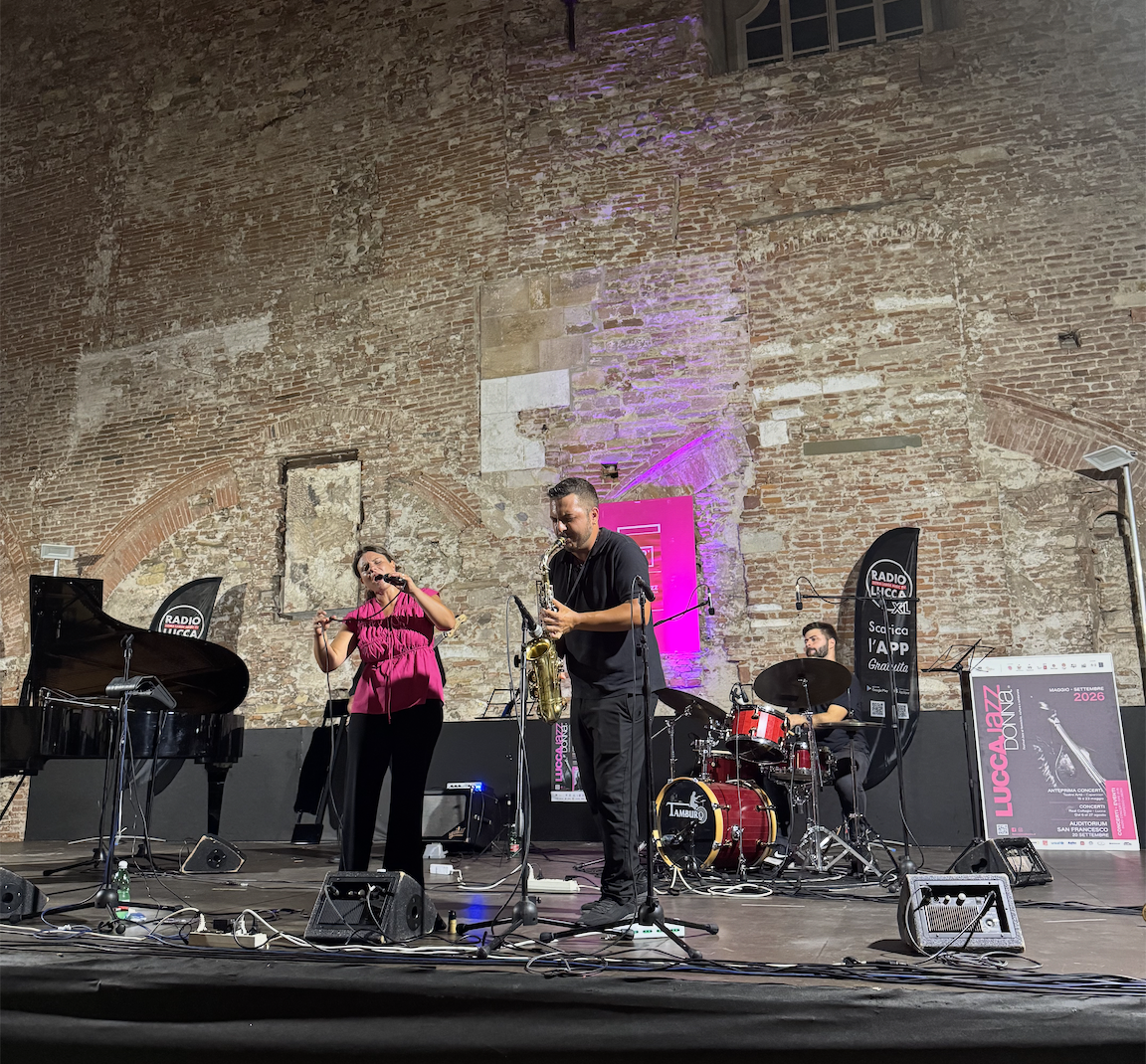
Finally, Lucia Filaci, singer, composer, and songwriter, brought A due voci to the stage, together with saxophonist Vittorio Cuculo and their quintet [2].
Three artists and their three different ways of inhabiting music. How wonderful! And it is precisely on the last of these three women that I would like to focus.
🎤 Lucia Filaci – A due voci

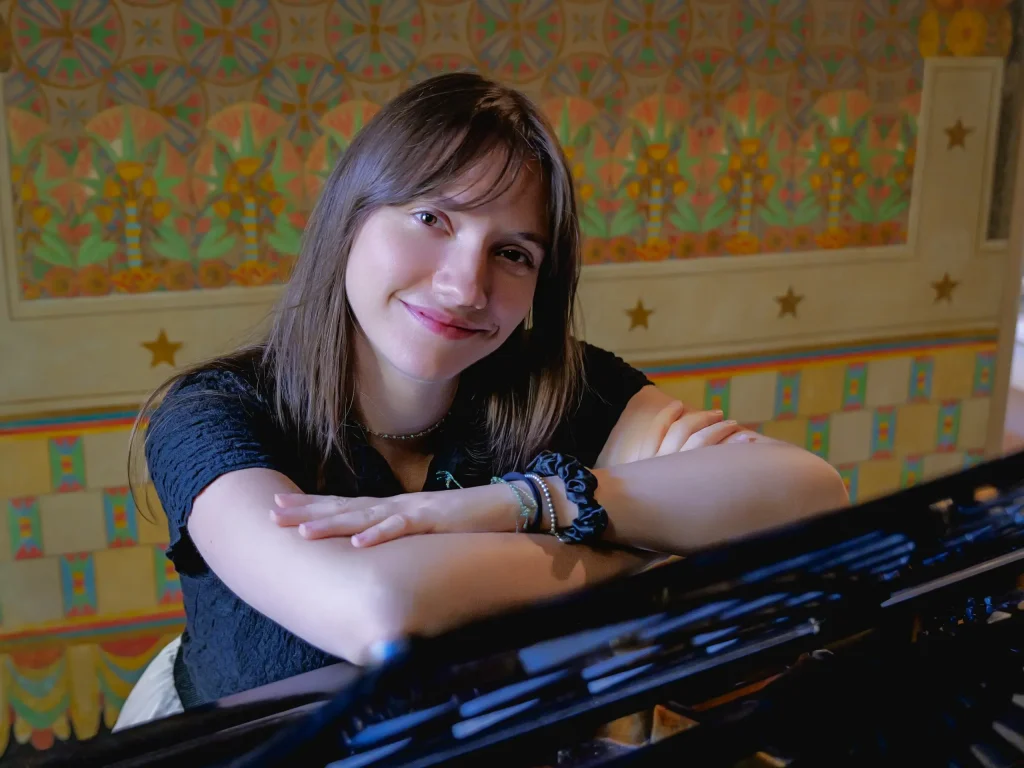
Lucia Filaci is a singer and composer whose musical journey began with classical and operatic training, before developing through jazz, improvisation, and original songwriting.
An artistic journey in which the voice is not merely an instrument for interpreting melodies and words, but becomes an instrument of exploration in its own right, capable of engaging in dialogue with other instruments and moving freely between different musical languages.
Her vocal exploration brings together an attention to technique, a love of scat singing, the language of bebop and hard bop, and the desire to write music with original lyrics in Italian [3].
And it is precisely from this desire for experimentation and dialogue that A due voci was born, the project she shares with saxophonist and composer Vittorio Cuculo.
On stage in Lucca, alongside them:
- Giuseppe Sacchi, piano and keyboards
- Giordano Panizza, double bass and electric bass
- Gianmarco De Nisi, drums
A quintet in which the voice and saxophone become partners in a musical conversation, supported by an ensemble that actively contributes to shaping the sound [2][3].
And here, the voice breaks through every barrier: it is not the typical jazz voice that expresses itself primarily through lyrics with a more pop-oriented flavour, but a leading instrument in its own right, on equal footing with a saxophone, a trumpet, or a clarinet.
🎧 A due voci: when music becomes dialogue
Released on November 28, 2025, by Alfa Music, A due voci grew out of the artistic encounter between Lucia Filaci and Vittorio Cuculo, who had already won the jazz category of LAZIOsound 2025.
An album that places at its centre a concept as simple as it is fundamental to jazz music: mutual listening.
The voice does not simply sing over the saxophone, just as the saxophone does not merely accompany the voice.
The two instruments seek each other out, respond to one another, support each other, and give each other space, building a dialogue in which each maintains its own identity.
What is interesting is how this principle also runs through the album’s writing: original compositions, Italian lyrics, improvisation, references to the jazz tradition, and openings towards contemporary, pop, and electronic sounds [4].
Indeed, the album’s journey develops from predominantly acoustic atmospheres towards an increasingly experimental sonic dimension.
In Che confusione, electronic nuances emerge, while in the closing track, Mi metto nella musica, voice, saxophone, and electronics intertwine in a particularly daring exploration of timbre [4].
But what I find most interesting is the very idea behind the project.
In an interview with Musica Jazz, Lucia and Vittorio explain how their work was born from the desire to build an authentic and equal dialogue between two solo instruments.
To listen, to propose, to respond. To give space and, at the same time, to find the courage to occupy it.
A balance in constant motion [3].
And perhaps this is precisely one of the most fascinating aspects of jazz: the possibility of building something together without giving up one’s own voice, unique and unrepeatable.
This encounter between equal voices is what jazz was founded upon at its origins, what its unwritten manifestoestablished: “the voice must become an instrument, and the instrument must become a voice.”
Why has this idea faded away? Why is the voice in jazz so often considered to be in need of “accompaniment”, while the saxophone, or any other traditional instrument, is considered an integral part of the group’s musical texture?
I saw how Lucia had completely overcome this barrier of “accompaniment”: there was no longer any division, hierarchy, or distance, not even physical distance, on stage. It was a velvety blend, as smooth as cream.
Finally!
This, for me, is the deepest meaning of making jazz. And my hope is that it will also be embraced by the younger generations, who are fortunate to have more positive role models to follow, with the aim of overcoming that divide between singers and instrumentalists which, unfortunately, is still very much alive and continues to fuel misleading and one-sided stereotypes.
🌹 Mary recommends…
A due voci — Lucia Filaci & Vittorio Cuculo (2025)
I recommend exploring the entire album, but three tracks in particular:
Fra ragione e sentimento, the first single released from the album, in which the language of jazz meets influences from Italian song.
Notte, a ballad that Lucia dedicated to Vittorio, her partner in life as well: a piece born from a personal bond and the desire to translate an experience of intimacy and sharing into music.
Mi metto nella musica, the closing track, which opens the quintet’s musical exploration towards electronic sounds and new expressive possibilities [3][4].
From Florence to Lucca, once again, the journey became an opportunity to discover new musical perspectives.
And Lucca Jazz Donna offered me an example of how a festival can place female creativity at its centre, not merely through the presence of women on stage, but by finally giving full space to their ideas, their compositions, and their artistic projects.
Because this is precisely where Le Jazziste by Mary begins.
From the desire to seek out, listen to, and tell the stories of the women who contribute to making jazz a living, constantly evolving form of music.
A journey that continues… one (or more) jazzwomen at a time.
Happy listening!
From jazz (and Tuscany) with love,
🌹 Mary xx
Sources and Further Reading
[1] Lucca Jazz Donna
[2] Lucca Jazz Donna — Official Programme
[3] Musica Jazz — “A due voci”: Interview with Lucia Filaci and Vittorio Cuculo
[4] RaiNews — “A due voci”, the New Album by Lucia Filaci & Vittorio Cuculo
*All photos (except for the portrait of Lucia Filaci) by Mary Blengino